

What exactly have we created in captivity?
I have kept boas for years.
Big snakes. Muscular snakes. Generally rather lovely snakes, despite the reputation they've acquired over the years.
And, like most keepers of a certain vintage, I grew up with two sets of initials firmly lodged in my head.
BCC and BCI.
Boa constrictor constrictor and Boa constrictor imperator.
Except there's a small problem.
BCI isn't BCI anymore.
Modern genetic work supports the separation of the Central American lineage as Boa imperator, distinct from the predominantly South American Boa constrictor. And once I started looking into exactly what had happened to our boas, things became considerably more complicated. Genetic work has revealed substantial population structure across Boa, while published studies have even included known crosses between animals historically identified as B. c. constrictor and B. c. imperator.
So, if different Boa populations naturally vary, if imperator and constrictor have been crossed in captivity, and if humans have spent decades selecting and crossing captive boas for appearance and other desirable characteristics...
What exactly is the generic “common boa” sitting in somebody's vivarium?
BCC, BCI, WTF?
Boa imperator and Boa constrictor can hybridise in captivity and produce viable offspring, while captive breeding records indicate that mixed ancestry can subsequently persist through breeding lines.
We now know the first cross isn't necessarily a genetic dead end.
That's critical.
An imperator × constrictor animal can enter the captive breeding population. Its descendants can then be bred into other lines. Again. And again. And again.
After several generations, you're no longer necessarily looking at something conveniently identifiable as:
50% BCC / 50% BCI.
You could potentially have an animal overwhelmingly descended from imperator while retaining some constrictor ancestry introduced generations earlier.
And unless somebody maintained an accurate pedigree, you wouldn't necessarily know.
This is what the current boa hobby itself struggles with. Breeders openly discuss what terminology should be used for animals sold as Boa imperator when known constrictor ancestry exists somewhere in their breeding history.
The common boa problem
Because “common boa” is where all this science collides with the bloke standing at a reptile show looking at a £120 snake in a RUB.
That's the animal you're interested in.
Not a documented Suriname locality constrictor. Not a carefully maintained Hog Island line. Not a breeder who has twenty years of pedigree records.
The ordinary boa sold as:
Common boa.
Common BCI.
Colombian boa.
Boa constrictor.
Boa imperator.
Common red tail.
These are the tags we see and recognise as “BOA”. And we’re back to large muscular snakes 8-12 feet long, 20-year lifespan, 70% relative humidity and up to 31°C on the basking spot. Just like any of the 100 different care sheets tell you to do.
But what do these labels actually tell us about the animal's ancestry? So, in turn, what care sheet do we look at for the averages?
Because this isn't a hypothetical problem.
We have the breeding records.
Boa keepers have deliberately crossed geographically distinct populations for decades. Hog Island boas have been bred to mainland Hypo animals to produce Hypo Hogs, with those offspring subsequently bred together and into further projects such as Sunset and Blood lines. One breeder's own records describe a Hypo Hog project beginning with a red/orange Hypo male bred to a Hog Island female, while later records document those descendants carrying Salmon Hypo, Hog Island and Blood ancestry.
And it doesn't stop at mixing populations of Boa imperator.
Roswell Laddertail projects provide an even more obvious example. Keeper records openly describe Roswell animals as carrying both constrictor and imperator ancestry. In one discussion from 2012, a breeder describes his Roswell Laddertails as 50% BCC and 50% BCI and considers breeding them back to Suriname constrictor specifically to prevent the BCC contribution becoming increasingly diluted as Roswells were bred further into BCI lines. Other experienced keepers in the discussion talk about changing the percentage of BCC and BCI ancestry as an entirely practical breeding consideration.
That's important.
We're not looking back at thirty years of boa breeding and guessing that this might have happened.
Boa breeders were discussing it while they were doing it.
And, importantly, none of this means those breeders did anything wrong. In many cases the ancestry was carefully recorded, the crosses were deliberate and the resulting animals were exactly what the breeder intended to produce. Even today, specialist keepers distinguish between pure locality animals and locality crosses; a Hypo Hog, for example, is explicitly recognised as a Hog Island animal crossed with another locality to introduce the Hypo gene.
The problem comes when that history stops travelling with the snake.
One breeder becomes three. Three generations become six. An animal is sold, bred again, sold again and eventually its great-great-whatever-grandchildren arrive on a table at a reptile show with a label saying:
Common boa — £120.
At that point, Boa imperator may be a perfectly reasonable species label. But it doesn't necessarily tell us which populations contributed to that particular animal. And in some documented captive lines, even the boundary between imperator and constrictor has been crossed.
Which brings me back to that care sheet.
Whose average are we using?
Your average boa
Boas, if you start looking at the different localities, come in all shapes and sizes.
Some are big, heavy-bodied animals. Others are considerably smaller and more slender. Some populations make extensive use of trees and arboreal hunting opportunities, while others spend considerably more time around the ground. Diet changes with locality and opportunity too, as do patterns of activity.
This isn't simply something boa breeders have noticed in captivity.
We can see it in the wild.
Research on Boa imperator from islands off Belize found animals averaging approximately half the length and one-fifth the body mass of boas living on the nearby mainland. The island animals weren't simply miniature versions either. Differences were found in their body proportions, including relatively longer tails and changes in head morphology associated with their more arboreal lifestyle. Subsequent research found a heritable component to this island dwarfism and showed that similar dwarf forms have evolved independently on different islands.
Food follows the animal.
Some of those small island boas exploit seasonally abundant migratory birds, with individuals climbing into vegetation to take relatively small avian prey. Cayos Cochinos — the home of the animals we know in herpetoculture as Hog Island boas — gives us another example. Field research there records boas using both structurally complex ground habitat and arboreal positions, while prey includes lizards and seasonally available birds.
Move north into Mexico and things change again. Mexican boas occur across an extraordinary variety of environments, from tropical deciduous forest and thornscrub through grassland, oak woodland and areas of Sonoran Desert. In the northern reaches of their distribution, activity appears strongly seasonal, increasing during the warm summer months and around the summer monsoon.
This is all Boa biology.
But it isn't one average boa.
And that's where our generic care sheet begins to look a little less useful.
A wild boa isn't simply produced to a standard specification. Geography, available prey, climate and habitat have shaped different populations in different ways. Natural selection has produced different sizes, different proportions and different ways of exploiting essentially the same basic boa toolkit.
The comparison is striking:
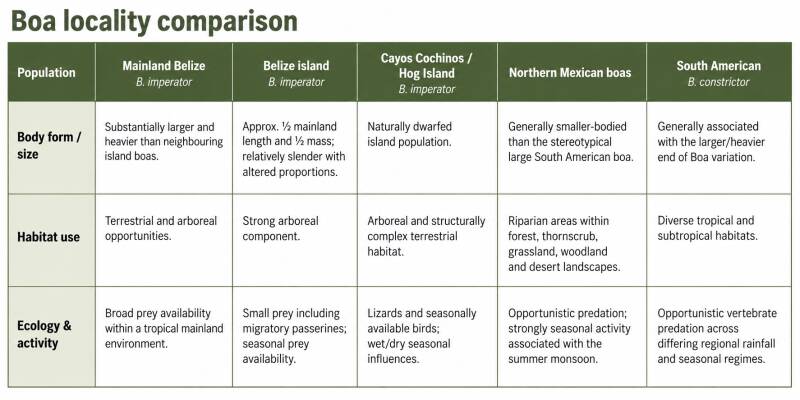
The table deliberately describes broad documented patterns rather than pretending every individual within a locality behaves identically.
And perhaps the most useful comparison is the one we can actually put numbers against:
Wild mainland and island boa body size
Relative averages reported for Belize island Boa imperator compared with nearby mainland animals.
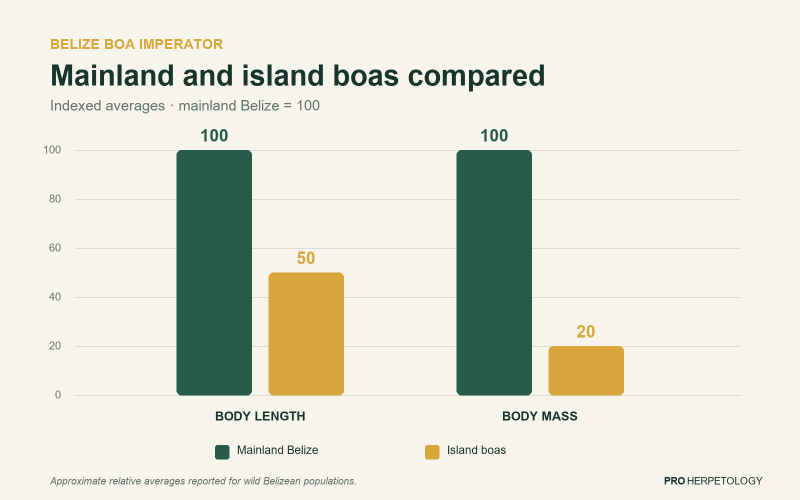
Mainland values shown as an index of 100; island values represent the reported approximate relative difference, not absolute length or mass.
Half the average length. One-fifth the mass.
And these aren't different animals that merely happen to look vaguely boa-shaped. They're geographically separated populations within the same Central American lineage.
So now let's bring herpetoculture back into the room.
We took animals descended from populations like these and moved them around the world. We bred Colombian animals to Panamanian animals. We bred mainland animals to island animals. We introduced locality-derived traits into other morph lines. We even crossed imperator with South American constrictor, producing viable offspring, while mixed ancestry subsequently became incorporated into captive breeding lines.
Then, after generations of captive breeding, we sometimes reduced the resulting animal to two words:
Common boa.
So what exactly is the average we're supposed to use?
If I know I'm keeping a pure Hog Island boa, its natural history gives me somewhere useful to start. If I know I'm keeping a locality-pure Suriname constrictor, I can investigate that population. The same principle applies to an animal of known Colombian, Mexican or other provenance.
But if I've got a generic captive boa whose ancestry disappeared somewhere between breeder number four and owner number seven, pretending that I know precisely which wild population represents that animal becomes rather more difficult.
And perhaps that's where we've been looking at husbandry from the wrong direction.
Maybe we don't need to find the average boa.
Maybe we need to start looking at the boa we've actually got.
What boa? What care?
And now we arrive at the slightly awkward question.
If the boa sitting in front of me has a documented locality, I've got somewhere to start. I can look at the climate, habitat, prey and behaviour of that population and use its natural history to inform how I keep it.
But what if it doesn't?
What if my boa is the descendant of several different populations? What if somewhere in its ancestry a Hog Island boa met a Colombian boa, which was later bred into another morph line, before somebody introduced constrictor ancestry several generations further down the road?
What husbandry does that animal need?
Do I keep the humidity high because part of its ancestry came from a humid tropical environment? Lower because another part didn't? Do I provide a high basking temperature because that's what the care sheet says, or might this particular animal consistently choose something cooler?
Do I build upwards and provide branches, shelves and elevated hides because some wild boa populations make considerable use of arboreal opportunities? Or do I look at the big chunky snake sitting in front of me, decide boas are terrestrial and give it four feet of empty air above its head?
This is where ancestry can only take us so far.
We cannot look at a boa that's 50% this, 25% that and something else several generations ago and calculate its husbandry accordingly. There is no formula where a little Hog Island reduces the basking temperature by two degrees and a splash of Suriname adds another ten percent humidity.
That's not how animals work.
What the ancestry tells us is something much more useful.
It tells us to expect variation.
If wild boas occupy different habitats, attain different sizes, exploit different prey and use their environments differently, then a captive boa of uncertain or mixed ancestry shouldn't necessarily be expected to conform perfectly to one set of averages either.
So perhaps the answer isn't choosing between high humidity and low humidity.
Provide a humidity gradient.
Don't choose between an elevated basking opportunity and a cooler environment.
Provide a thermal gradient.
Don't decide whether your boa is arboreal or terrestrial.
Give it both.
Branches. Shelves. Elevated hides. Secure ground-level hides. Warm positions. Cooler positions. Areas of higher humidity and somewhere drier. Cover, open space and enough room for the animal to move between them.
Then comes the important bit.
Watch the bloody snake.
Where does it spend its time?
Does it repeatedly climb after dark? Does it choose an elevated hide or disappear beneath something at ground level? Which part of the thermal gradient does it use after feeding? Does its position change through the day? Does it seek more humid areas approaching ecdysis? Does it move between opportunities seasonally? Is it maintaining good body condition on the feeding regime you've chosen, or are you producing a four-foot sausage because the care sheet told you to feed every seven days?
Those observations won't tell you whether great-great-grandad came from Suriname.
They don't need to.
They tell you something considerably more useful for day-to-day husbandry.
They tell you what the animal in front of you is actually doing.
And this doesn't mean throwing natural history away. Quite the opposite.
Natural history establishes the range of possibilities we should consider. It tells us that boas climb. They use cover. They exploit different thermal environments. They experience changes in humidity and rainfall. They encounter different prey. They aren't sitting in the wild maintaining themselves at 31°C and 70% humidity because somebody laminated a care sheet.
Our job in captivity isn't necessarily to identify one perfect number and hold the enclosure there.
Our job is to provide enough appropriate opportunities that the animal can make some of those decisions for itself.
Perhaps that matters even more with the generic captive boa.
Because after decades of locality mixing, morph breeding and occasional constrictor × imperator crosses, we may genuinely not know exactly what biological history is sitting in front of us.
But we can still give it choices.
And then we can watch what it does with them.
Wait and watch
After all of that—taxonomy, locality, genetics, hybridisation, morph breeding and thirty-odd years of herpetoculture—we're left with something surprisingly simple.
Watch the animal in front of you.
Affording opportunity is always going to be one of the best, and potentially the only, ways of establishing whether you've actually got things right.
Every animal is an individual, and every individual is different.
Take two hypothetical boas with exactly the same ancestry. Both Hog Island, Suriname and imperator mixes. Same age. Same size. Put them into two identical enclosures with exactly the same opportunities and I would put money on them using those enclosures differently.
One might climb every night. The other might barely leave the ground.
One might spend hours basking openly while the other heats itself beneath cover.
One might regularly sit in the water bowl. The other might never enter it.
One might disappear into an elevated hide every morning while its sibling buries itself beneath the leaf litter.
Neither animal is necessarily doing it wrong.
They're making choices.
And that's the bit I think we sometimes miss when designing reptile enclosures.
Providing a branch doesn't mean the snake has to climb it. Providing a deep substrate doesn't mean it has to burrow. Providing an elevated hide doesn't mean it has to sleep there. Providing different temperatures, humidity levels, cover and exposure doesn't dictate behaviour.
It makes behaviour possible.
If the animal never uses the branch, fine. But if there isn't a branch, you've learned absolutely nothing about whether it wanted to climb.
That's the difference between providing an opportunity and prescribing an existence.
And once those opportunities are there, we have to do something reptile keepers aren't always particularly good at.
Wait.
Then watch.
Not for ten minutes after you've finished decorating the enclosure. Not just when you walk past at lunchtime. Watch over days, weeks and months. Watch at different times of day. Watch after feeding. Watch before a shed. Watch when the weather changes and when the seasons change.
Patterns emerge.
And those patterns tell us far more about the animal we're actually keeping than assuming everything we need to know was written on a care sheet for the average boa.
Care sheets have their place. They give us sensible biological parameters and somewhere safe to begin. Natural history gives us something even better: an understanding of the opportunities the animal might need.
But neither can tell us exactly how this individual will use them.
That's the animal's job.
Our job is to give it the chance.
Because whether your boa is a pure locality animal, a carefully documented morph, a constrictor × imperator cross or thirty years of captive breeding wearing a £120 price tag, the principle remains exactly the same.
Provide the opportunities. Wait. Watch. Adjust.
Let the boa tell you whether you've got it right.
That's considerably more useful than matching the enclosure to a care sheet, shouting “done”, and leaving the room.
Scientific literature
Boback, S.M. (2005). Natural history and conservation of island boas (Boa constrictor) in Belize. Copeia, 2005(4), 880–885. DOI: 10.1643/0045-8511(2005)005[0879:NHACOI]2.0.CO;2. ResearchGate
Boback, S.M. (2006). A morphometric comparison of island and mainland boas (Boa constrictor) in Belize. Copeia, 2006(2), 261–267. DOI: 10.1643/0045-8511(2006)6[261:AMCOIA]2.0.CO;2. DOI
Booth, W., Johnson, D.H., Moore, S., Schal, C. & Vargo, E.L. (2011). Evidence for viable, non-clonal but fatherless Boa constrictors. Biology Letters, 7(2), 253–256. DOI: 10.1098/rsbl.2010.0793. PubMed Central (PMC)
Card, D.C., Schield, D.R., Adams, R.H., Corbin, A.B., Perry, B.W., Andrew, A.L., Pasquesi, G.I.M., Smith, E.N., Jezkova, T., Boback, S.M., Booth, W. & Castoe, T.A. (2016). Phylogeographic and population genetic analyses reveal multiple species of Boa and independent origins of insular dwarfism. Molecular Phylogenetics and Evolution, 102, 104–116. ScienceDirect
Card, D.C., Adams, R.H., Schield, D.R., Perry, B.W., Corbin, A.B., Pasquesi, G.I.M., Row, K., Van Kleeck, M.J., Daza, J.M., Booth, W., Montgomery, C.E., Boback, S.M. & Castoe, T.A. (2019). Genomic basis of convergent island phenotypes in boa constrictors. Genome Biology and Evolution, 11(11), 3123–3143. DOI: 10.1093/gbe/evz226. PubMed
Hynková, I., Starostová, Z. & Frynta, D. (2009). Mitochondrial DNA variation reveals recent evolutionary history of main Boa constrictor clades. Zoological Science, 26(9), 623–631. DOI: 10.2108/zsj.26.623. ResearchGate
Reed, R.N., Boback, S.M., Montgomery, C.E., Green, S., Stevens, Z. & Watson, D. (2007). Ecology and conservation of an exploited insular population of Boa constrictor (Squamata: Boidae) on the Cayos Cochinos, Honduras. In R.W. Henderson & R. Powell (eds.), Biology of the Boas and Pythons, pp. 388–403. Eagle Mountain Publishing. dickinson.hykucommons.org
Reynolds, R.G., Niemiller, M.L. & Revell, L.J. (2014). Toward a Tree-of-Life for the boas and pythons: Multilocus species-level phylogeny with unprecedented taxon sampling. Molecular Phylogenetics and Evolution, 71, 201–213. DOI: 10.1016/j.ympev.2013.11.011. faculty.umb.edu
Van Devender, T.R. et al. (2020). Distribution and ecology of the northernmost Mexican West Coast Boa Constrictor (Boa sigma). Herpetological Review, 51(3), 433–438.
Herpetocultural and breeding records
RedTailBoas.com (2012). Thoughts on breeding Suriname to Roswell Laddertail (50% BCC, 50% BCI). Contemporary breeder discussion documenting Roswell animals described as 50% BCC/50% BCI and proposed backcrossing to Suriname animals. Red Tail Boas
SnakeHaus. Locality vs Morph. Specialist husbandry/breeding resource distinguishing pure Hog Island boas from Hypo Hog locality crosses and describing introduction of the Hypo trait through crossbreeding.
Add comment
Comments