


Omelette was an egg eating snake.
And she was beautiful.
She was wild caught, hated everyone and everything around her and refused to eat.
We were off to a great start.
Breaking eggs
Omelette was a Dasypeltis gansi – the West African egg eating snake. She arrived at my former employer’s premises in August of 2020 and, as a wild caught specimen, she was dehydrated and skinny. There was a strong possibility of a heavy parasite load and refusal to feed must also be taken into consideration.
Given this was an egg eater and the species had a reputation for being reluctant feeders, I was not overjoyed at this arrival. At the time I was reptile supervisor of the company, but that title meant little more than “someone to blame when it all went wrong”. I had no control over orders or the running of the room thanks to the general manager. He was a self-proclaimed reptile expert and did all orders and animal purchases on the section.
This was a long-standing problem. The title of reptile supervisor gave me responsibility for what happened on the section, but very little control over what actually arrived on it.
Anyway, I digress. I could tell you about the advice the GM sought from an external “vet friend”, I could tell you about the advice he got from his “zookeeper friend”, or I could tell you the truth. No one could get this animal to feed.
The pinkie heads soaked in egg (yes that was some of the advice given) were regurgitated – kinda obvious that one. Small chicken eggs were refused – another obvious one given the size of the animal. The egg eater was kept in a 3 litre BRA plast box in a warm rack and it wasn’t doing anything but fading away.
Something had to be done.
So I did
Home again, home again
I bought her, I took my hard-earned cash and handed it over to take this one home. It was that or watch her fade.
I wish I could say that this was the first time it had happened. It was not. I had watched this happen before and then been assigned the blame for the entire situation. Things did improve with time, but right now in 2020, things were pretty dismal.
Off we went. This was an impulsive, off the cuff, not thought through idea. I had no enclosure ready to go, no tested heat or UV lighting and I wasn’t overly familiar with Dasypeltis gansi natural history.
Reading time.
I read every single piece I could find on West African egg eating snakes, natural history, captive records, diet, feeding habits, everything.
I made chaotic notes and sat back after the research hours and read through them.
Physical Adaptations
- Size: Adults grow from about 2.5 to 3 feet long and average around 500 grams in weight. Females growing slightly larger than males.
- Toothless Mouth: They lack true teeth because they do not need to catch or hold active prey. Instead, they have small ridges to grip slick eggshells.
- Stretchy Jaws: Extra-stretchy skin between the lower jawbones allows them to swallow whole eggs three to four times wider than their own heads.
- Internal Egg-Cracker: Specialized downward projections on their neck vertebrae (hypophyses) act like an internal saw or can-opener to slice through the shell after swallowing.
Diet and Feeding Behaviour
- Strict Diet: They eat only bird eggs, detecting fresh eggs by smell while ignoring rotten ones or those with advanced, hard-to-digest embryos.
- Swallowing and Regurgitation: The snake swallows the egg whole, uses its muscular body and spinal projections to crush the shell inside the oesophagus, drinks the liquid contents, and then regurgitates the crushed, empty shell.
- Proportional Record: Relative to its small body size, the Gans's egg-eater can swallow larger prey items than massive constrictors like the Burmese python.
Habitat and Defence
- Habitat: They live mainly in the savannahs and coastal bushes of West Africa, often climbing into trees and shrubs to find hidden bird nests.
- Predator Mimicry: When threatened, they defend themselves by rubbing their heavily ridged scales together to produce a sharp, hissing or rattling sound, mimicking dangerous vipers while striking out.
Enclosure & Habitat Setup
West African egg-eaters are semi-arboreal, excellent climbers that thrive when given vertical space.
- Enclosure Size: A minimum 2-3 foot vertical aligned terrarium is ideal for an adult. Front-opening enclosures are preferred to minimize stress when reaching inside.
- Climbing Elements: Provide plenty of sturdy branches, cork bark, and artificial plants. They will actively climb to look for "nests" or to find a high, secure hiding spot.
- Substrate: Use a moisture-retaining but well-ventilated substrate like a mix of coco coir, orchid bark, or cypress mulch. Avoid sand or highly dusty materials.
Temperature, Lighting, & Humidity
As a native to West African savannahs and woodlands, this species requires a warm environment.
- Temperature Gradient: Maintain a warm basking side of 31°C to 33°C using an overhead ceramic heat emitter or deep heat projector. The cool side of the tank should drop to around 23°C to 25°C.
- Lighting: While they are primarily nocturnal or crepuscular, providing a low-output UVB light strip or coil helps regulate their circadian rhythm and aids in calcium metabolism.
- Humidity: Keep ambient humidity moderate, around 40% to 60%. Provide a humid hide filled with damp sphagnum moss to assist them during their shedding cycles.
Temperament & Handling
- Gentle Disposition: They are generally docile and handleable, though they can be quite flighty and fast when young.
- The "Bluff" Defence: If startled in their enclosure, they may hiss loudly by rubbing their scales together or strike with an open mouth. Because they lack teeth, a "bite" feels like nothing more than a harmless, blunt tap.
I had an idea of what I had to do.
The build
The as yet unnamed egg eater was around 18 inches long, so I decided, instead of going big too fast, to build her into a 30 x 30 x 45cm Exo Terra glass enclosure. UVB canopy and small 40-watt heat lamp over the top. Loads of plants (I like plants, thankfully so do egg eaters) a finch nest that I had left over from a rescue I did a few years back – don’t ask. Hides and climbing opportunities.
Time to get her in
Her reaction to the house
Omelette tentatively slithered into the new enclosure and took off. She shot straight up into the highest point and disappeared into one of the high hides.
I left her to it.
I gave her a couple more hours of heat and light then I turned her off until the morning.
Bright and early, coffee in hand, I was staring at the enclosure. And I was rewarded with
Nothing.
Omelette hadn’t moved from her hide, and I wasn’t about to drag her out of there.
Off I went to work. Only to find out the GM wanted to get another egg eating snake because the other had sold so quickly. I shut that down as quickly and efficiently as I could explaining that I had bought her and she had died overnight.
No more wild caught egg eaters this time.
Bullet dodged.
I ambled through a day of pretty much nothing but noise and fighting the system and got myself home. Quickly.
I rushed to the front of Omelette’s enclosure and stared. Nothing.
She still hadn’t moved.
I still wasn’t going to rush her. She would come out in her own time.
Later that night she did. I didn’t get to see this as I was snoring quite happily, but in the morning, I saw carnage. With a side of devastation.
Omelette had demolished her enclosure. Plants were broken, the water bowl was full of substrate and debris, branches moved and hides upside down. Good. This was promising.
Eggs for dinner
It was feeding time. But how do you introduce food to an egg eating snake? Normal feeding routine for me at the time was – defrost rodent, warm rodent, watch a fanatical strike or wait patiently while the snake decides if it’s hungry this week.
Both of those scenarios involve the snake actively hunting and deciding if it wants to feed.
Egg eaters are static feeders. They don’t hunt per se, they don’t wait in ambush to constrict an unwary rodent, and they don’t have to overwhelm another living thing. They find eggs, assess if they are undeveloped enough to ingest or if they are rotten.
So what would hunting behaviour look like in this animal?
Time to find out.
Button quail, budgies and finches were the eggs of choice. I was hoping that – if – she got larger, her size of egg would increase too. For the moment I had a semi reliable supply thanks to a friend of mine who bred the birds and regularly had excess or infertile eggs. Time to see if it would work.
I introduced three eggs into a “nest”, a plastic bowl with hay and moss and the eggs underneath. This girl wasn’t a hunter but I hoped to elicit a feeding response by introducing the smell of eggs in a nest.
I had no idea if it would work, but Omelette needed the chance. She hadn’t eaten for I don’t know how long. Egg eaters in the wild would feast for six months a year and then starve for the other six. Was Omelette captured in feast or famine? Would her feeding habits change in a captive environment? Could I even get her feeding? These eggs were not her usual fare, would she recognise them as edible?
Waiting it out
She didn’t feed.
I checked and there were three eggs. I left them a further 24 hours.
Still three.
I removed them, made another nest, added another three and waited.
I checked the following morning.
Still three.
I left it 24 hours and checked again.
There was a crushed egg at the bottom of the tank. Sat on a leaf. I almost missed it.
I took it out and examined it closely. It was fascinating. The egg had been sawn through to create a weak point in the egg, it had been crushed in a very deliberate manner to extract the insides and then, promptly, thrown up. The unneeded shell, not the contents.
I was ecstatic.
I quickly and quietly removed the egg and shut the doors. Opened them again to remove my trapped finger and closed them again.
Through great personal sacrifice and monstrous amounts of restraint, I left Omelette alone for another 24 hours and checked again the following evening. Two more eggshells. Magical. The feeding was on.
While she was feeding, I kept the eggs coming. She was taking six eggs a week. Comfortably. The only issue was, my friend didn’t have enough eggs coming through and we were dangerously close to the end of the laying season. I needed a solution. And it came from the supermarket.
Quail eggs.
Regular, bog-standard quail eggs. Coturnix quail to be specific. Readily available and easy to come by at most large supermarkets. But were they going to be too big for little Omelette?
Turns out she was fine. Her gape was impressive to borderline insane.
She handled the quail eggs comfortably and feasted until the end of October. She then had Christmas off. She didn’t pick up another feed again until mid-April of 2021.
Omelette shed and grew and ate and did everything that an egg eating snake should do.
But one thing changed. She became quiet and gentle, and she didn’t panic or run anymore. No threats, no bluff strikes and no more baleful glares if she was caught out of her hides.
The end
Omelette was upgraded into a 2 foot by 2 foot wooden vivarium where she lived out the rest of her days.
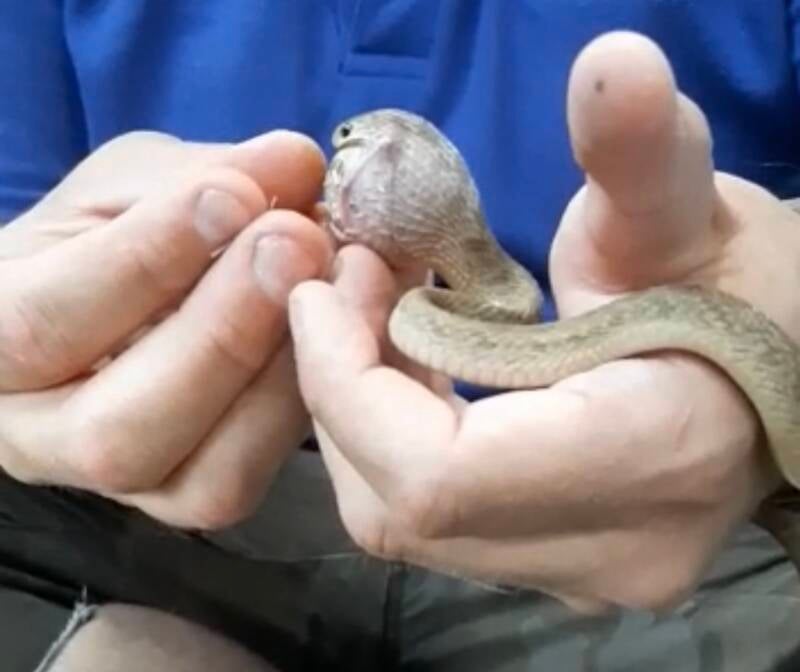
Watching this girl eat became the highlight of my week. I was lucky enough to get to the stage that I could hand feed her. She would sit on one hand and eat an egg from my other one.
You could actually hear the egg crack inside her. The specialised inward-pointing projections associated with the vertebrae work with the oesophagus as part of an egg-processing system that crushes and collapses the shell, allowing the contents to be swallowed before the empty shell is compacted and regurgitated.
On to my hand. Never have I been happier to see a snake regurgitate. Or have smushed eggshell in my hand.
She lived for another four years with me and she remains, to this day, the most specialist and remarkable species I have ever had the privilege of keeping.
And you know what they say
You have to break some eggs to make an Omelette.

Add comment
Comments