

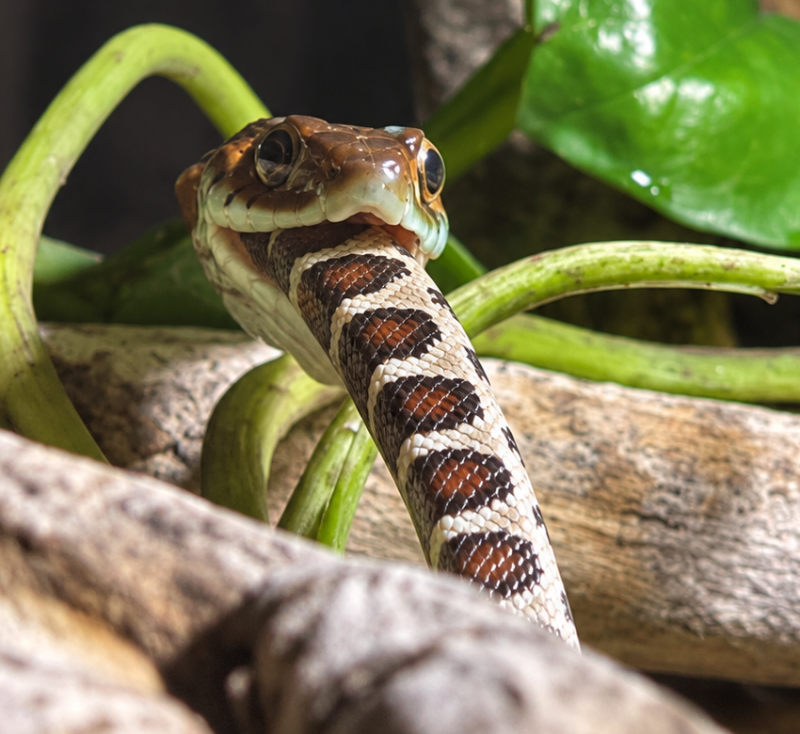
Defensive behaviour, chemical recognition and an unusual feeding observation in a California red-sided garter snake
PRO Herpetology | Behavioural Observation | 15 October 2026
Parky is not what you might call a conventional garter snake.
A California red-sided garter snake (Thamnophis sirtalis infernalis), he arrived with a collection of neurological and sensory peculiarities that make ordinary movement something of an adventure. Coordination is questionable, his head occasionally points in unexpected directions, and gravity remains an ongoing source of disagreement. Or entertainment. Depends which side you’re looking from.
Yet Parky functions remarkably well within his limitations. He explores, investigates, feeds independently and even hunts his own earthworms. His enclosure has been adapted to accommodate his unusual movement patterns and reduce the consequences of falls.
He is, in short, a functioning garter snake who occasionally does things upside down.
And on 15 October 2026, he gave us something rather interesting to think about.
An unexpected introduction
Boots was a young corn snake × milk snake hybrid who had died following a failure to thrive. He was considerably smaller than Parky, approximately one-third of his total length.
When we lose a small animal, Penny and I sometimes consider whether its remains can serve as a food source for another. It isn't a conventional approach, and certainly isn't one we'd recommend without considering the circumstances, but we prefer the idea of nutrients being returned to another animal rather than simply discarded.
When Boots' body was presented to Parky as a potential food source, we anticipated one of two responses.
Parky might investigate and feed, or he might investigate and wander off.
That is generally how he responds to unfamiliar food items. His diet has included multiple types of fish, different species of rodents, frog legs and several species of earthworm. He is certainly not unfamiliar with dietary variety.
But he had never previously been offered another snake. Or in fact another reptile.
And his response was not what we expected.
On encountering Boots, Parky flattened his neck and anterior body, opened his mouth, extended his tongue and delivered what appeared to be a defensive bluff strike before retreating.
This was markedly different from his usual response to unfamiliar food.
For a moment, it appeared that Boots was something to avoid rather than something to eat.
Then Parky returned.
He investigated the body again and began swallowing it, headfirst.
He eventually consumed Boots completely.
The entire sequence raised a question that was considerably more interesting than whether a garter snake could eat another snake.
What had Parky recognised during that first encounter?
Snake-eating snakes
The consumption of snakes by other snakes is known as ophiophagy.
It is particularly associated with kingsnakes (Lampropeltis), although the behaviour is not exclusive to them.
Garter snakes are more commonly associated with diets containing earthworms, amphibians, fish and other small vertebrates. Nevertheless, snake consumption has been documented within Thamnophis.
Venegas-Barrera and Manjarrez (2001) reported a Mexican garter snake (Thamnophis eques) consuming a Mexican alpine blotched garter snake (Thamnophis scalaris).
A separate investigation into the ecology of T. scalaris found snakes among the vertebrate prey consumed by larger individuals (Manjarrez et al., 2007).
These observations establish that ophiophagy occurs within the genus, although they do not demonstrate that it is a regular dietary strategy in California red-sided garter snakes.
Parky's behaviour was therefore unusual within our own experience, but not without precedent in the wider genus.
What interested us most was what happened before he began feeding.
When food looks like a predator
Garter snakes do not experience their surroundings through vision alone.
Chemical information is fundamental to how snakes investigate their environment. Tongue-flicking allows them to collect chemical particles, which are processed through the vomeronasal system.
These cues can help snakes assess potential food, other animals and environmental threats.
For a small snake, recognising another snake as a potential predator could be particularly important.
Weldon (1982) investigated the responses of garter snakes to chemical stimuli from snake-eating species.
The study demonstrated that members of Thamnophis, including T. sirtalis, could discriminate between chemical stimuli from different snakes. Responses to certain ophiophagous species included increased tongue-flicking compared with control stimuli.
Importantly, increased tongue-flicking demonstrates chemical detection and investigation. It does not, by itself, establish fear or a defensive response.
A later study by Placyk and Burghardt (2011) explored chemically elicited antipredator responses in Thamnophis sirtalis, examining populations with differing histories of exposure to ophiophagous milk snakes.
Adults from populations occurring alongside milk snakes generally showed stronger responses to milk snake chemical cues than adults from populations without that association.
The researchers also investigated predator-naïve newborn garter snakes and the effects of experience with predator-associated chemical stimuli.
Their findings suggested that both inherited and experiential influences can contribute to antipredator responses.
This is where Boots becomes particularly interesting.
Boots was not simply another small snake.
He was a corn snake × milk snake hybrid.
And milk snakes belong to Lampropeltis, a genus containing well-documented snake predators.
Could Parky have detected chemical characteristics associated with Boots' milk snake ancestry and initially responded as though confronted with a potential threat?
It is a plausible question.
But it is not an established answer.
What we saw — and what we didn't
Our observation was straightforward.
Parky encountered the deceased hybrid snake, displayed behaviour consistent with defence, retreated, returned to investigate and subsequently consumed the body headfirst.
We did not conduct a controlled experiment.
We did not isolate scent from visual or tactile information. We did not compare his response with a deceased corn snake, a pure milk snake or another unfamiliar reptile.
We also have no evidence establishing which chemical characteristics Boots inherited from either parent species.
His milk snake ancestry does not automatically mean that his scent resembled the cues used by garter snakes to recognise predators.
Furthermore, Parky's longstanding neurological and sensory abnormalities introduce another interpretive complication. We cannot assume that every movement or response he displays has the same underlying cause as it might in a neurologically typical individual.
His initial response might have involved chemical recognition, visual novelty, tactile information, unfamiliarity or several factors acting together.
The fact that he subsequently ate Boots does not establish that he stopped recognising a predator, nor that his initial behaviour was necessarily caused by predator recognition.
What we can say is that his response differed noticeably from his previous encounters with unfamiliar food items.
That difference is worth documenting.
From defence to feeding
Parky's return to Boots introduced a second interesting observation.
He swallowed the deceased snake headfirst.
Headfirst ingestion is documented in other snake-eating species. Jackson, Kley and Brainerd (2004) examined the biomechanical challenges of ophiophagy in California kingsnakes, including how snake prey can be accommodated during ingestion.
Greene (1976) investigated the role of scale orientation in helping some ophiophagous snakes identify the direction of their prey.
These studies provide useful comparative context, although they do not establish how Parky located Boots' head.
Nor should his consumption be described as hunting.
Boots was already deceased. Parky did not pursue, overpower or kill him.
The behaviour we observed was the consumption of a deceased heterospecific snake following an initial defensive display.
That distinction matters.
The question Parky left us
This was a single captive observation involving an unusual individual and an equally unusual food item.
It cannot establish a new behavioural mechanism or demonstrate predator recognition through hybrid-associated chemical cues.
But it brings together several established areas of herpetological research: ophiophagy, chemical discrimination, antipredator behaviour and feeding responses.
Most importantly, it reminds us that behaviour rarely comes with an explanation attached.
We saw a defensive display.
We saw a retreat.
We saw renewed investigation.
And we saw feeding.
The temptation is to join those events together into a tidy story about a garter snake recognising a predator before deciding to eat it.
Perhaps that is what happened.
Perhaps it isn't.
The science gives us reasons to ask the question, not permission to claim the answer.
For us, that is the value of careful observation. An unexpected response can lead us back to the literature, challenge our assumptions and suggest questions that might otherwise never have occurred to us.
Parky may never behave quite like another garter snake.
But that doesn't make his behaviour unworthy of attention.
And for one afternoon, the little fellow who occasionally struggles to work out which way is up gave us a rather good lesson in why we should keep watching.
Parky the wannabe kingsnake.
Whether he recognised Boots as a potential predator or simply encountered an unfamiliar meal, we cannot say.
But he certainly gave us something to think about.
References
Greene, H. W. (1976). Scale overlap, a directional sign stimulus for prey ingestion by ophiophagous snakes. Zeitschrift für Tierpsychologie, 41, 113–120.
Jackson, K., Kley, N. J. & Brainerd, E. L. (2004). How snakes eat snakes: the biomechanical challenges of ophiophagy for the California kingsnake, Lampropeltis getula californiae (Serpentes: Colubridae). Zoology, 107, 191–200.
Manjarrez, J., Venegas-Barrera, C. S. & García-Guadarrama, T. (2007). Ecology of the Mexican alpine blotched garter snake (Thamnophis scalaris). The Southwestern Naturalist, 52(2), 258–262.
Placyk, J. S., Jr. & Burghardt, G. M. (2011). Evolutionary persistence of chemically elicited ophiophagous antipredator responses in gartersnakes (Thamnophis sirtalis). Journal of Comparative Psychology, 125(2), 134–142. https://doi.org/10.1037/a0022883
Venegas-Barrera, C. S. & Manjarrez, J. (2001). Thamnophis eques and Thamnophis scalaris: Predator/prey. Herpetological Review, 32(3), 187.
Weldon, P. J. (1982). Responses to ophiophagous snakes by snakes of genus Thamnophis. Copeia, 1982(4), 788–794. https://doi.org/10.2307/1444088
Add comment
Comments