

In this article, we will outline the natural diet — and the captive equivalents — to give your lizard, snake, amphibian, or invertebrate the optimum amount of nutrition to keep the animal happy and healthy. We will also describe the reason for additional calcium and other supplements and explain their benefits to the animal.
Because, much like humans, reptiles perform considerably better when they are not surviving entirely on junk food and poor life choices.
Diet Variety
In a natural setting, lizards, snakes, amphibians, and invertebrates are opportunistic feeders and will tackle almost anything they can identify as food and overpower. Reptiles are not generally picky eaters in the wild. If it moves and fits in the mouth, there is usually at least a brief moment of consideration.
You will find some family-favourite reptiles eating some truly strange things in nature:
- Leopard geckos raiding nests of baby mice
- Praying mantids devouring hummingbirds
- Bearded dragons feasting on centipedes and venomous spiders
- Corn snakes wrestling fence lizards
- Monitor lizards raiding crocodile nests for eggs and hatchlings
- Boa constrictors swallowing monkeys whole
Nature is considerably more dramatic than most people expect from animals that spend half the day sitting under a heat lamp.
It may not always be possible to replicate such a varied diet in captivity, but offering different food items when possible is beneficial both nutritionally and behaviourally. Variety encourages natural feeding responses and provides a broader range of nutrients.
It also prevents your reptile from becoming the equivalent of a child who will only eat chicken nuggets.
Nutritional Value
Not all food is created equally. Different prey items contain varying levels of fat, protein, calcium, vitamins, minerals, and phosphorus. Whole prey items such as rodents and birds provide a broad nutritional profile because snakes and large lizards consume everything — organs, skin, fur, bone, tails, and all.
In other words, reptiles do not waste food. Somewhere, a nutritionist is nodding approvingly while a squeamish human quietly leaves the room.
Below is a nutritional comparison of commonly used whole prey items:

The differences may not look enormous on paper, but over the lifetime of an animal they matter. A mouse, rat, chick, quail or rabbit is not simply the same meal wearing a different outfit. Each provides a slightly different nutritional package, which is another reason we prefer dietary variety wherever it is appropriate for the species.
As snakes and larger lizards consume the entire prey animal, a varied diet of appropriately sized whole prey items can often reduce the need for major supplementation. This varied intake helps maintain healthy body condition and promotes steady growth in younger animals.
That being said, we still recommend “rump dipping” a prey item in supplements once a month to ensure trace vitamins and minerals are present in the diet.
Yes, “rump dipping” sounds ridiculous. No, reptile keepers are not allowed to rename it something more dignified.
Why Do We Use Calcium Powders with Reptiles?
Calcium supplements have been used in reptile collections for as long as reptiles have been kept in captivity. But why?
(Sciency bit disclaimer.)
Calcium supplementation is commonly used to correct the calcium-to-phosphorus ratio of captive diets, particularly those containing feeder insects. Many commonly used feeder insects contain considerably more phosphorus than calcium, producing an inverse Ca:P ratio. As a general husbandry target, a dietary ratio of approximately 2:1 calcium to phosphorus is widely recommended.
If dietary calcium is inadequate, or the animal is unable to absorb sufficient calcium, the body still has to maintain circulating calcium levels for essential functions such as muscle contraction and nerve transmission. Calcium may therefore be mobilised from skeletal reserves, and chronic imbalance can contribute to metabolic bone disease.
Which is biologically clever in the short term and absolutely disastrous in the long term.
This imbalance can rapidly lead to:
- Metabolic Bone Disease (MBD)
- Muscular dysfunction
- Skeletal deformities
- Poor growth rates
Live insects and vegetation should therefore be dusted with a quality calcium powder to ensure adequate calcium intake.
Calcium is especially important in:
- Growing juveniles
- Gravid females
- Egg-laying species
Young reptiles grow rapidly, while gravid oviparous reptiles require large amounts of calcium to form eggshells. Building skeletons and eggs is expensive business, nutritionally speaking.
Below is a nutritional breakdown of common feeder insects:
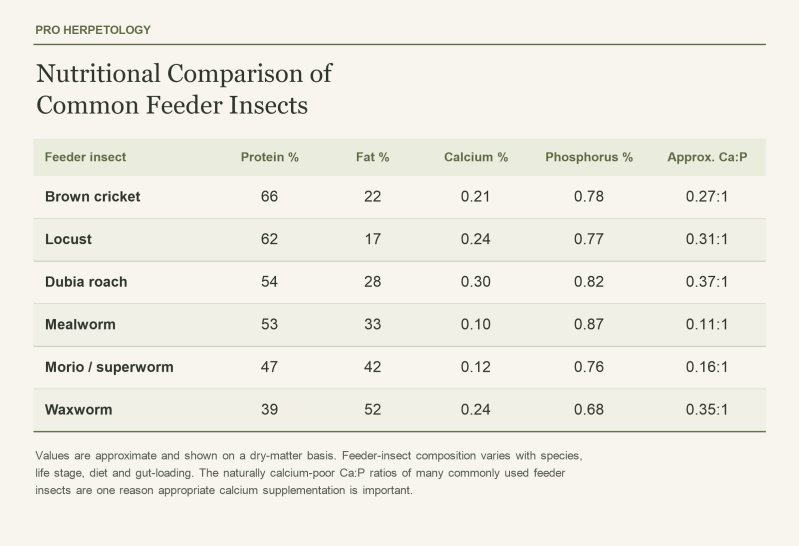
Waxworms, for example, are essentially reptilian doughnuts. Delicious, highly appreciated, and best offered in moderation unless your gecko is training for competitive obesity.
Why Do We Use Vitamin and Mineral Supplements with Reptiles?
Supplementation is frequently discussed in reptile keeping, and for good reason.
During the late 1960s, tortoises became wildly popular “garden pets.” Unfortunately, proper supplementation and husbandry knowledge were almost entirely absent. Combined with poor heating and lighting, this resulted in catastrophic mortality rates.
The scale of the historic tortoise trade is difficult to comprehend today. Between 1969 and 1972 alone, around 480,000 spur-thighed tortoises were imported into Britain. Earlier reports on the trade estimated first-year mortality as high as 99%, with only one or two animals in every hundred surviving their first year in captivity.
That is not a typo. Those figures are horrifying, but they also provide some historical context for modern reptile nutrition. Knowledge of calcium, vitamins, minerals, appropriate diet, heating and UV provision has developed enormously since then. Supplementation isn't something we do simply because reptile keeping has become more complicated; much of modern husbandry exists because we learned, sometimes at an appalling cost to the animals, what happens when their biological needs are not met.
In the wild, reptiles naturally obtain vitamins and minerals through varied diets and environmental exposure. In captivity, commercially produced insects and vegetables may lack certain micronutrients, which is why supplementation becomes necessary.
Important vitamins include:
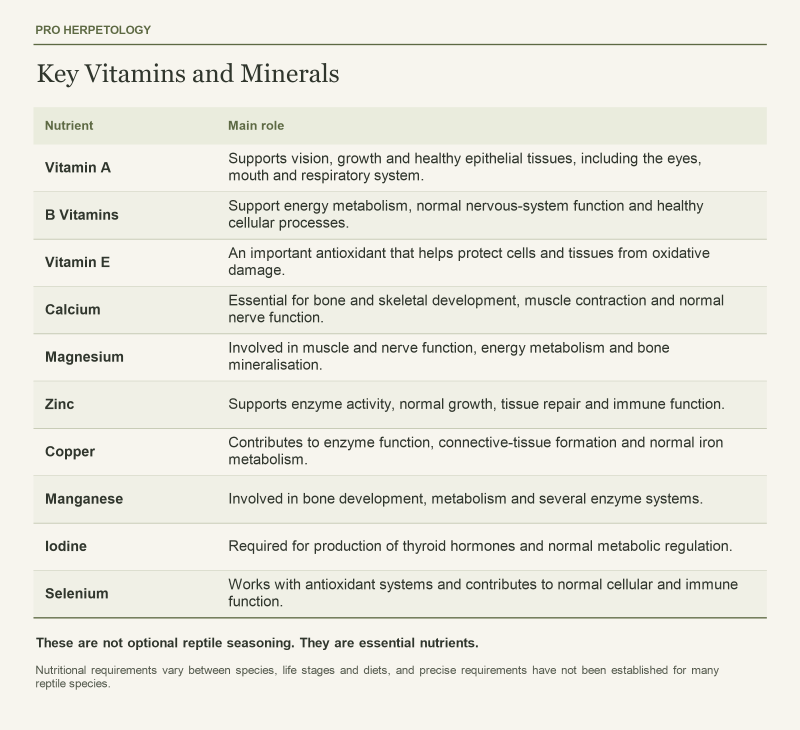
Which is why supplementation should never be viewed as “optional reptile seasoning.”
Vitamin D3 and UV Lighting
One of the most important vitamins for reptiles is vitamin D3.
Vitamin D3 can be provided through supplementation, but many reptiles can also produce it naturally when exposed to appropriate UVB lighting. UVB begins the process within the skin, with heat helping convert the resulting compounds into usable vitamin D3.
This heat-driven conversion is known as thermal isomerisation.
(Last sciency bit. Promise.)
Vitamin D3 then allows the animal to absorb and use calcium effectively. Without sufficient vitamin D3, even a calcium-rich diet may not provide the animal with the calcium it needs.
Without adequate UVB exposure and calcium metabolism, even the best diet can fail.
Which means your reptile may technically be eating well while simultaneously building bones with the structural integrity of damp cardboard.
Conclusion
There is a huge amount of conflicting information online regarding the “best” reptile diet. In our opinion, a varied diet combined with appropriate calcium and vitamin/mineral supplementation provides the best opportunity for healthy growth, long-term health, and natural feeding behaviour.
We have experimented extensively with new foods, complete diets, supplementation combinations, and edible enrichment items for captive reptiles. Some worked brilliantly. Others were received with the exact level of disdain only a reptile can provide while staring silently from beneath a basking lamp.
Ultimately, good nutrition is one of the most important aspects of reptile care. A well-fed reptile is healthier, more active, more resilient — and significantly less likely to view your fingers as an experimental food source.
Add comment
Comments